
Why gold and diamonds are woven into the fabric of every Indian celebration.
More than adornment
In India, jewellery has never been merely decorative. It is blessing, security, identity and story, all at once. A gold coin gifted at a birth quietly becomes a family's foundation; a mother's polki set becomes a bride's inheritance; a slim bangle slipped onto a newborn's wrist becomes the first chapter of a life. To wear jewellery here is to wear memory — and to gift it is to say, without a single word, 'I want to be part of your story.'
The language of occasions
Every celebration speaks its own jewelled dialect. Weddings call for the grandeur of polki, kundan and heavy gold — pieces meant to be photographed, remembered and passed down. A first job or a graduation is often marked with delicate diamond studs, small enough to wear every day yet significant enough to never forget. Festivals invite something auspicious and new; anniversaries, something intimate and personal. Learning to read these occasions is part of the joy — and part of the craft of choosing well.
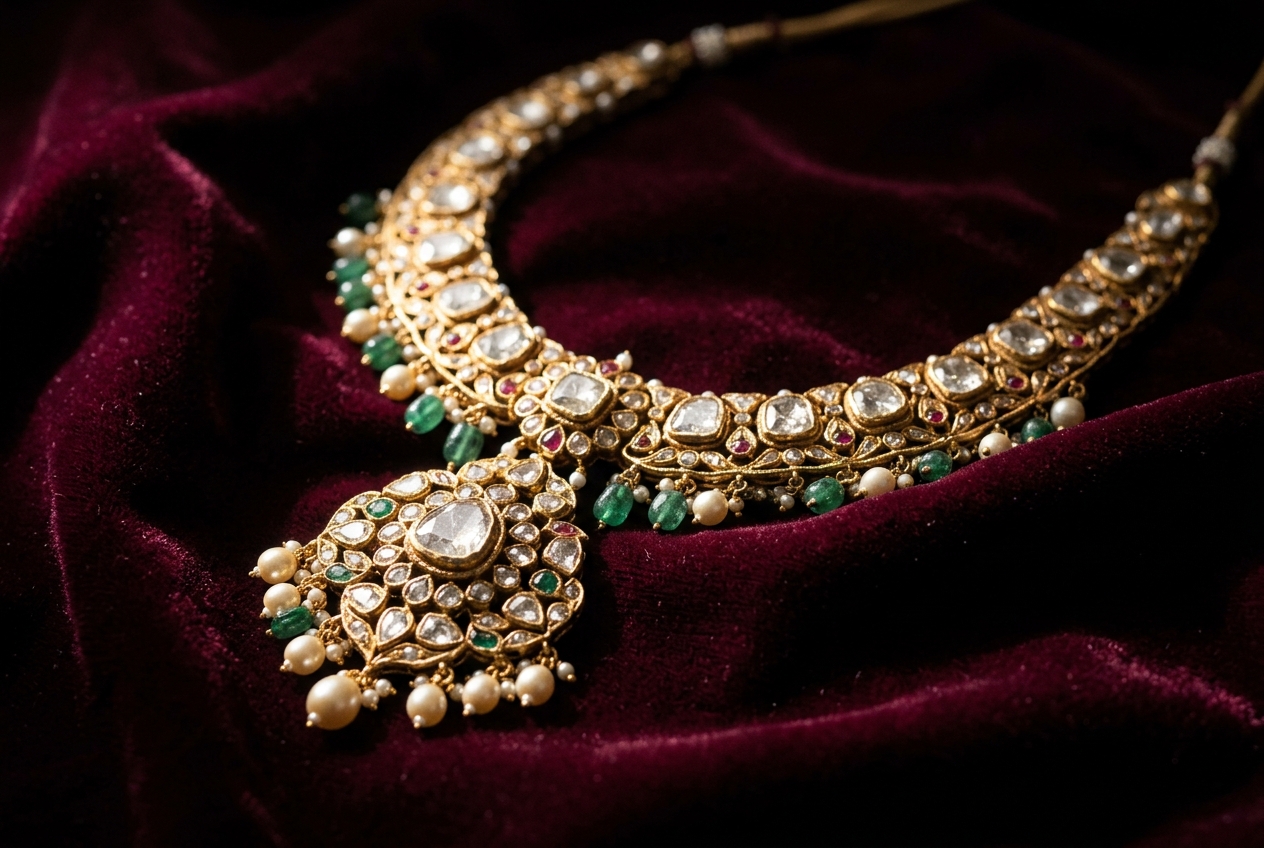
Sacred gold
Gold occupies a place in Indian life that few materials anywhere can claim. It is considered auspicious — a symbol of the goddess Lakshmi herself, of prosperity welcomed into the home and blessings invited into a marriage. This is why no celebration feels complete without it, why it is gifted at every threshold of life, and why its purity is treated as a matter of trust rather than mere metal. A hallmarked gram of gold is, in a very real sense, a small act of faith kept honest.
The regional richness of Indian craft
India does not have one jewellery tradition; it has dozens, each shaped by its region and its history. From the intricate meenakari enamelling and kundan of the north to the temple jewellery of the south, from filigree to jadau, every technique carries the fingerprints of the artisans who kept it alive across generations. To buy Indian jewellery thoughtfully is to become a quiet custodian of one of these living traditions — to keep a craft breathing simply by choosing to wear it.
The wedding, and the weight of forever
Nowhere does jewellery matter more than at a wedding. The bridal set is chosen months in advance, debated by families, blessed, photographed and then kept for a lifetime — often to be worn again by the next bride in the family. This is jewellery at its most meaningful: not an accessory to the day, but a witness to it, and a bridge between the generation being celebrated and the ones still to come.
Tradition that moves forward
Tradition is not about standing still. The most respected houses reinterpret heritage designs for a new generation — making pieces lighter, more wearable, more suited to modern life, without losing the meaning that made them matter. A polki necklace redesigned so a granddaughter will actually wear it is not a break from tradition; it is exactly how tradition survives. The craft endures because it is allowed, gently, to grow.
Carrying it on
Ultimately, Indian jewellery is a conversation across time — between the grandmother who saved for it, the mother who wore it, and the daughter who will inherit it. To choose it with care, to keep it well, and to pass it on is to keep that conversation alive. That, more than gold or diamond, is the true value of what we make.
Every piece we make is chosen backwards — from the memory it will one day hold.
Continue Reading

